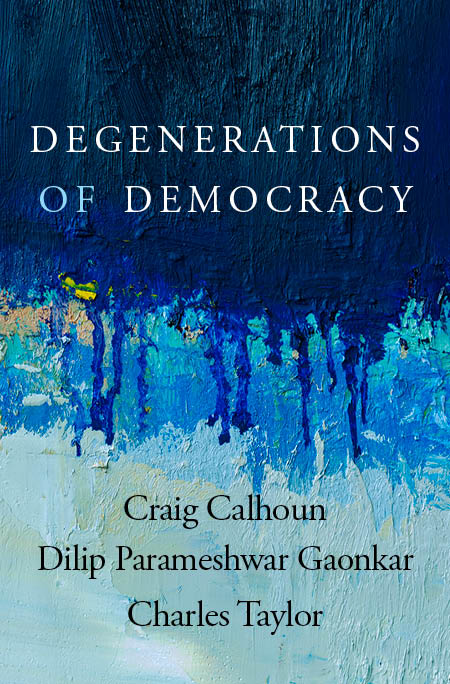
Degenerations of Democracy

Calhoun, Craig, Dilip Gaonkar, and Charles Taylor. 2022. Degenerations of Democracy. Harvard University Press. 

Three leading thinkers analyze the erosion of democracy’s social foundations and call for a movement to reduce inequality, strengthen inclusive solidarity, empower citizens, and reclaim pursuit of the public good.

degenerations of democracy

Democracy is in trouble. Populism is a common scapegoat but not the root cause. More basic are social and economic transformations eroding the foundations of democracy, ruling elites trying to lock in their own privilege, and cultural perversions like making individualistic freedom the enemy of democracy’s other crucial ideals of equality and solidarity. In Degenerations of Democracy three of our most prominent intellectuals investigate democracy gone awry, locate our points of fracture, and suggest paths to democratic renewal.

Social Movements: The Structure of Collective Mobilization

Almeida, Paul. 2019. Social Movements: The Structure of Collective Mobilization. University of California Press.

Social Movements the Structure of Collective Mobilization

Social Movements cleverly translates the art of collective action and mobilization by excluded groups to facilitate understanding social change from below. Students learn the core components of social movements, the theory and methods used to study them, and the conditions under which they can lead to political and social transformation.

This fully class-tested book is the first to be organized along the lines of the major subfields of social movement scholarship—framing, movement emergence, recruitment, and outcomes—to provide comprehensive coverage in a single core text.

Q&A with Kiyoteru Tsutsui

Co-Winner of the 2019 Political Sociology Book Award

Rights Makes Might: Global Human Rights and Minority Social Movements in Japan (Oxford University Press, 2018)

Rights Make Might

How did you start working on the book and how did the project evolve over time?

The book project started as a follow-up to a series of articles that I’d worked on since my dissertation, which examined how ideas and institutions around universal human rights emerged and evolved since around the 1940s. These articles featured cross-national quantitative analyses that identified some interesting global-local dynamics in human rights politics: many states make discursive commitments to human rights without actually changing their practices, and only when civil society actors leverage those commitments do actual practices improve. Other researchers also confirmed this pattern, and I had some anecdotal evidence to underscore the argument, but I wanted to have a deeper understanding about how these processes unfold. So I set out to do a comparative case study, and the three cases in Japan offered an excellent setting for this process-tracing study.

Trade Battles: Activism and the Politicization of International Trade Policy

Kay, Tamara and R.L. Evans. 2019. Trade Battles: Activism and the Politicization of International Trade Policy. New York: Oxford University Press.

Trade BattlesTrade was once an esoteric economic issue with little domestic policy resonance. Activists did not prioritize it, and grassroots political mobilization seemed unlikely to free trade advocates. The passage of the North American Free Trade Agreement in the early 1990s was therefore expected to be a fait accompli. Yet, as Trade Battles shows, activists pushed back: they increased the public consciousness on trade, mobilized new constituencies against it, and demanded that the rules of the global economy protect the collective rights and common good of citizens. Activists also forged a sustained challenge to U.S. trade policies after NAFTA, setting the stage for future trade battles.

Using data from extensive archival materials and over 215 interviews with Mexican, Canadian, and U.S. trade negotiators; labor and environmental activists; and government officials, Tamara Kay and R.L. Evans assess how activists politicized trade policy by leveraging broad divisions across state and non-state arenas. Further, they demonstrate how activists were not only able to politicize trade policy, but also to pressure negotiators to include labor and environmental protections in NAFTA’s side agreements. A timely contribution, Trade Battles seeks to understand the role of civil society in shaping state policy. Order online at www.global.oup.com with promotion code ASFLYQ6 to save 30%

The Politics of Empowerment: Disability Rights and the Cycle of American Policy Reform

Pettinicchio, David. 2019. The Politics of Empowerment: Disability Rights and the Cycle of American Policy Reform. Stanford, CA: Stanford University Press

Politics of Empowerment

Politics of Empowerment

Despite the progress of decades-old disability rights policy, including the landmark Americans with Disabilities Act, threats continue to undermine the wellbeing of this population. The U.S. is, thus, a policy innovator and laggard in this regard. In Politics of Empowerment, David Pettinicchio offers a historically grounded analysis of the singular case of U.S. disability policy, countering long-held views of progress that privilege public demand as its primary driver. By the 1970s, a group of legislators and bureaucrats came to act as “political entrepreneurs.” Motivated by personal and professional commitments, they were seen as experts leading a movement within the government. But as they increasingly faced obstacles to their legislative intentions, nascent disability advocacy and protest groups took the cause to the American people forming the basis of the contemporary disability rights movement. Drawing on extensive archival material, Pettinicchio redefines the relationship between grassroots advocacy and institutional politics, revealing a cycle of progress and backlash embedded in the American political system.