Test, Measure, Punish: How the Threat of Closure Harms Students, Destroys Teachers, and Fails Schools

Michaels, Erin. 2025. Test, Measure, Punish: How the Threat of Closure Harms Students, Destroys Teachers, and Fails Schools: NYU Press.
In the last two decades, education officials have closed a rising number of public schools nationwide related to low performance. These schools are mainly located in neglected neighborhoods with high concentrations of poverty. Despite this credible threat of closure, relatively few individual schools threatened with closure for low performance in the United States are actually shut down. Yet, as Erin Michaels argues, the looming threat is ever present. Test, Measure, Punish critically shifts the focus from school shutdowns to the more typical situation within these strained public schools: operating under persistent risk of closure.
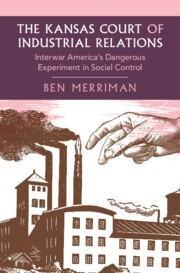
Kansas Court of Industrial Relations: Interwar America’s Dangerous Experiment in Social Control

Merriman, Ben. 2025. Kansas Court of Industrial Relations: Interwar America’s Dangerous Experiment in Social Control: Cambridge University Press.

The Kansas Court of Industrial Relations, founded in 1920, was the lone US trial of a labor court – a policy design used almost everywhere else in the industrialized world during the interwar period. What led Kansas to establish the KCIR when no other state did? And what were the consequences of its existence for the development of economic policy in the rest of the country? Ben Merriman explores how the KCIR’s bans on strikes and lockouts, heavy criminal sanctions, and unilateral control over the material terms of economic life, resulted in America’s closest practical encounter with fascism. Battered by the Supreme Court in 1923, the KCIR’s failure destroyed American interest in labor courts. But the legal battles and policy divisions about the KCIR, which enjoyed powerful supporters, were an early sign of the new political and intellectual alignments that led to America’s unique New Deal labor policy.

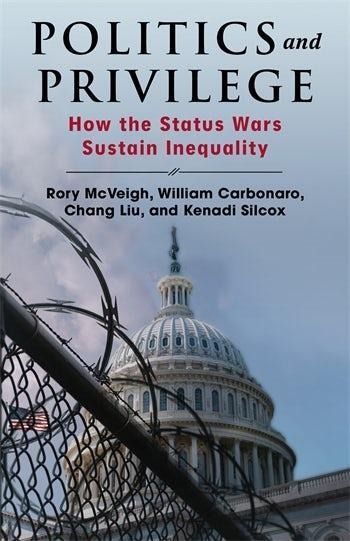
Politics and Privilege: How the Status Wars Sustain Inequality

McVeigh, Rory, William Carbonaro, Chang Liu and Kenadi Silcox. 2025. Politics and Privilege: How the Status Wars Sustain Inequality: Columbia University Press.

In the United States, the bottom 50 percent of households hold only 1 percent of the nation’s wealth. Scholars and commentators have long viewed democracy as the antidote to economic inequality, but US electoral politics bears little resemblance to a struggle between the haves and the have-nots. What makes extreme disparities of wealth and income so persistent, and why has the political process failed to address the problem?

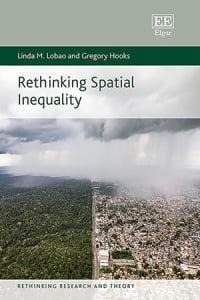
Rethinking Spatial Inequality

Lobao, Linda M and Gregory Hooks. 2025. Rethinking Spatial Inequality: Edward Elgar Publishing.

This illuminating book offers a new perspective on social science inquiry into the spatial dimensions of societal well-being; addressing the key question of who gets what, and where.

Leading scholars Linda M. Lobao and Gregory Hooks adopt an organizing framework that speaks to the concept of spatial inequality, how it forms a lens on societal disparities, and how it gives rise to work with underlying commonalities across different social science disciplines. With this scaffolding, the authors consider spatial inequality across spatial scales, places, and populations, including the subnational scale, so often missing in inequality research. Illustrative cases center on poverty, public service provision and austerity policies, environmental justice, and war and conflict. The book concludes by advancing an integrative social science agenda to guide future emancipatory research on inequality.

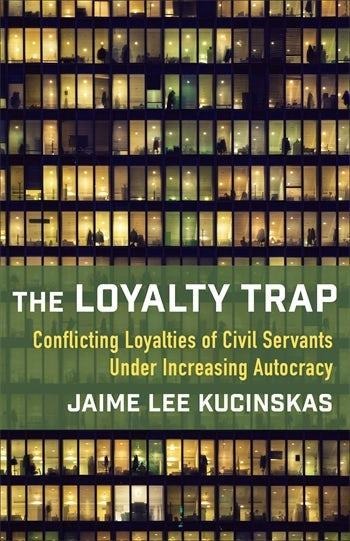
The Loyalty Trap: Conflicting Loyalties of Civil Servants under Increasing Autocracy

Kucinskas, Jaime Lee. 2025. The Loyalty Trap: Conflicting Loyalties of Civil Servants under Increasing Autocracy: Columbia University Press.

Donald J. Trump took office threatening to run roughshod over democratic institutions, railing against the federal bureaucracy, and calling for dismantling the administrative state. How do civil servants respond to a presidential turn toward authoritarianism? In what ways—if any—can they restrain or counter leaders who defy the norms of liberal democratic governance?