The Limiting Principle: How Privacy Became a Public Issue

Eiermann, Martin. 2025. The Limiting Principle: How Privacy Became a Public Issue: Columbia University Press.
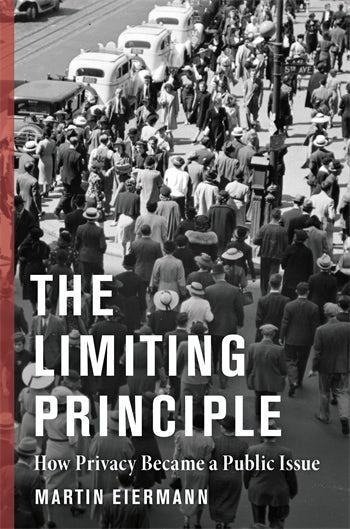
The concept of privacy is central to public life in the United States. It is the fulcrum of countless conflicts over reproductive rights and consumer protection, the power of tech companies and the reach of state surveillance. How did privacy come to take on such import, and what have the consequences been for American institutions and society?

Martin Eiermann traces the transformation of privacy from a set of informal cultural norms into a potent political issue. Around the turn of the twentieth century, in a nation that was searching for order amid rapid change and frequent moral panics about the ills of modern life, privacy spoke to emerging social problems and new technological realities. During this tumultuous period, political mobilization and judicial contestation shaped a legal, institutional, and administrative privacy architecture that has partly endured into the twenty-first century. Eiermann rebuts the claim that technological change renders privacy obsolete, demonstrating that the concept became increasingly capacious when it was applied to the social problems and political disputes of the information age. And he shows that it is often the selectivity—not the ubiquity—of governmental and corporate data collection that should elicit our concerns.

Disabled Power: A Storm, a Grid, and Embodied Harm in the Age of Disaster

Frederick, Angela. 2025. Disabled Power: A Storm, a Grid, and Embodied Harm in the Age of Disaster: NYU Press.

Every disaster is a disability disaster, argues Angela Frederick. Disabled Power tells the stories of Texans with disabilities who endured the 2021 Texas power crisis, which forced millions of Texas residents to endure a dayslong winter storm without heat or water. Based on 58 in-depth interviews with disabled Texans and parents of disabled children, Frederick highlights how disabled people and those with chronic health conditions are uniquely harmed when basic infrastructure such as power and water systems fail. She argues that the vulnerability people with disabilities experienced during this disaster was not an inevitable consequence of individual disabled bodies. Rather, disability vulnerability was “produced” by policies that “disabled” vital infrastructure.

The State and the Emergence of the First American Party System: Roll Call Voting in the New York State Assembly during the Early Republic

Rohr, B., & Martin, J. L. (2025). The State and the Emergence of the First American Party System: Roll Call Voting in the New York State Assembly during the Early Republic. American Sociological Review, 90(4), 726-754. https://doi.org/10.1177/00031224251344574

Prevailing theories about the nature and development of the democratic party system fail to account for the important case of the United States. Using a novel dataset on legislators and roll call votes in the New York State Assembly after the ratification of the U.S. Constitution, we show that, contrary to existing accounts, legislative parties had already formed at this early stage. Yet these parties did not arise from the translation of social cleavages such as economic or social class into political oppositions, as sociologists might expect, nor were they merely networks of powerful elites disconnected from the polity, as political scientists and historians have suggested. Instead, these parties coalesced around formal issues—structural questions like the procedures for election and appointment, questions whose answer would determine the rules of the game for future contests. Parties emerged, we argue, not because of an inherent need to adjudicate conflicts between sectors of the polity, but because of the organizational affordances of the modern democratic state. Our findings suggest the formation of party systems is an integral part of the formation of the modern state.

Secularism, sorting, and Americans’ political knowledge

Samuel L Perry, Secularism, sorting, and Americans’ political knowledge, Social Forces, 2025;, soaf150, https://doi.org/10.1093/sf/soaf150

Political knowledge, including knowledge of basic civics and current political conditions, is associated with a host of pro-democratic outcomes including institutional trust and civic and political participation. Religion is also historically associated with these outcomes, yet a link between religion and indicators of political knowledge remains underexamined. Integrating research on religion/secularism and political engagement with work on partisan sorting, I theorize self-consciously secular Americans, particularly if they are sorted politically, will exhibit the strongest grasp on basic civics and current political conditions. Analyses of data from a recent, nationally representative survey affirm my expectations. Self-identified atheists/agnostics consistently score significantly higher than religious or non-affiliated Americans on questions about basic civics and current political conditions. Interactions reveal that education helps most other religious groups catch up to atheists/agnostics on civics knowledge, but not knowledge about current politics. And on knowledge of both basic civics and current politics, atheists/agnostics’ advantage is strongest among liberals and Democrats and disappears among conservatives and Republicans. A similar pattern appears for evangelical Protestants in the opposite direction with their scores on both civics and current politics increasing significantly as they identify more with ideological conservatism, but this does not apply to partisan identity. Findings extend literatures on political knowledge, religious/secular political engagement, and partisan sorting by showing that (1) self-identified secular Americans, particularly if they are sorted, tend to be the most knowledgeable about basic civics and current political conditions, and (2) this pattern is to a weaker extent mirrored by evangelicals, another politicized religious group.

From Equality to Economic Development: Culture, Intersectionality, and Justifications for Women’s Entrepreneurship Policy in the United States, 1973–1988

Gracia J Lee, From Equality to Economic Development: Culture, Intersectionality, and Justifications for Women’s Entrepreneurship Policy in the United States, 1973–1988, Social Politics: International Studies in Gender, State & Society, 2025;, jxaf012, https://doi.org/10.1093/sp/jxaf012

This article examines the discursive strategies underpinning advocacy for women’s entrepreneurship policy in the United States between 1973 and 1988. It demonstrates a shift in policy justifications from equality to economic development leading up to the passage of the Women’s Business Ownership Act in 1988. This discursive shift shows how women evoked the cultural ideas of gender sameness and equal opportunity, yet their claims were further shaped by the masculine logics of small business, policy changes, and pushback against affirmative action in the 1980s. Bridging ideas from the civil rights, anti-poverty, and women’s movements in the United States and abroad, advocates also addressed the problems and interests of intersectionally marginalized poor mothers and Black women, alongside middle-class White women. The case of women entrepreneurs thus highlights the need for attention to the interplay between cultural ideas, the sociopolitical context, and intersectional dynamics when analyzing gender as a political category.