Emotions and the Nation: Nation-Building, Nationhood Reproduction, Political Mobilization, and Change

Feinstein, Yuval (2026). “Emotions and the Nation: Nation-Building, Nationhood Reproduction, Political Mobilization, and Change.” Nationalities Papers.

This article examines recent developments in three key areas of nationalism research that integrate emotions into theoretical frameworks and empirical analysis. First, it explores studies that revisit historical nation-building through the lens of the history of emotions. Second, it discusses how the “affective nationalism” literature has shifted the focus of banal nationhood reproduction from mental representations to emotions. Third, it reviews efforts to theorize the emergence of intense national emotions in certain periods and their role in political mobilization and change. The article highlights critical advancements across these areas, particularly in linking emotions to meaning through narratives, expanding research from national centers to the frontiers, and challenging the illusion of national harmony by emphasizing power dynamics and dialectical change. The conclusion suggests future research directions, including investigations of national emotions within diasporic communities and digital networks.
Right-wing Populist Political Movements

Morgül, Kerem. (2025). “Right-Wing Populist Political Movements.” Pp.7-13 in D. Snow, D. McAdam, & D. Moss (eds), Contemporary Social Movements: Historical and Descriptive Accounts. Wiley Blackwell.

The twenty-first century has seen a marked rise in the political influence of the right-wing populist parties and movements, distinguished by antiestablishment rhetoric, ethnonationalist fervor, and authoritarian tendencies. This chapter analyzes the defining characteristics of this global trend and the factors driving its ascent. Right-wing populism is conceptualized as an amalgamation of populism, ethnonationalism, and authoritarianism. Populism is defined by the mobilization of unified people around a transgressive political endeavor, simplifying politics into a conflict between the sovereign people and self-serving elites. Ethnonationalism underscores a shared ethnic identity as the foundation for national belonging, frequently advocating stringent immigration controls. Authoritarianism is evident in centralized power, the erosion of the rule of law, and constrained political freedoms. The proliferation of right-wing populism has been particularly pronounced in Europe, with notable instances in Hungary, Poland, Italy, and the Netherlands. Influential populist figures like Donald Trump and Jair Bolsonaro have also emerged globally, often challenging democratic institutions and advancing (ethno)nationalist agendas. The chapter explores the implications of these movements for democratic governance and societal cohesion. The rise of right-wing populism is examined through demand-side and supply-side explanations.

Corporate Accountability and the Ecological Turn: Mining Lessons from the Rights of Nature Movement

Dale, John G. 2025. “Corporate Accountability and the Ecological Turn: Mining Lessons from the Rights of Nature Movement,” in Raluca Grosesçu and John G. Dale, eds., Corporate Accountability for Human Rights Violations: Civil Society and Transnational Action across the World (Series on Interdisciplinary Studies in Human Rights, vol.16, Springer Nature, Cham, Switzerland), pp. 73-100. https://doi.org/10.1007/978-3-032-05569-9_4

As Big Tech-driven development of artificial intelligence and data mining becomes increasingly entangled with traditional practices of extractivist mining for oil, gas, coal, and precious metals and minerals, the corporate accountability movement now must take into consideration (living and non-living) nonhuman rights to adequately defend and mobilise support for the humans, communities, ecosystems, and knowledge being impacted. Drawing on relational approaches to rights projects, this chapter examines a transnational, Indigenous-led rights of nature movement in Ecuador that successfully pre-empted the rights and extractive practices of transnational and state-owned mining corporations while creating new rights to protect Indigenous communities, the Amazonian forests they inhabit, and novel legal forms of data ownership. I then compare this case to a U.S.-focused corporate accountability movement that had separately and differently constructed rights of nature to challenge corporate rights of extractivist development. I demonstrate how the rights of nature project in Ecuador subsequently engaged and influenced this U.S.-based rights project, including its relational discourse on rights of nature and community, political aims and strategies of corporate accountability, and its movement identity.

Social Bias in AI: Re-coding Innovation through Algorithmic Political Capitalism

Samuel O. Carter and John G. Dale. 2025. “Social Bias in AI: Re-Coding Innovation through Algorithmic Political Capitalism.” AI & Society (2025) 40:6. https://doi.org/10.1007/s00146-025-02540-2

This research examines the social dynamics underpinning algorithmic bias, proposing a framework for addressing these issues through the lens of algorithmic political capitalism. We explore how socio-technical-ecological relations of power often reproduce harmful algorithmic effects, including social bias, data exploitation in the knowledge economy, prejudiced predictions, and unexamined user biases that obscure power asymmetries and harm society. Building on complexity theory, particularly Morçöl’s definition of public policy as a dynamic system with co-evolving relationships between actors and systems, we analyze the challenges and opportunities to mitigate these harms within a multilayered framework. Our framework extends Keller and Block’s concept of ‘technology-dependent political capitalism’, incorporating mechanisms to ensure government assistance is conditional, allowing bicameral governance in supported corporations, and empowering local and state authorities to hold organizations accountable. Finally, we highlight the crucial roles of transparency, accountability, and democratization in fostering meaningful innovation, and argue that addressing algorithmic bias and the inequities of the knowledge economy requires a nuanced understanding of the interplay between public policy, technological systems, and societal structures. Our proposals aim to reshape the socio-technical-ecological landscape, creating conditions for algorithmic innovation that align with democratic values and equitable societal progress, while mitigating systemic violence.

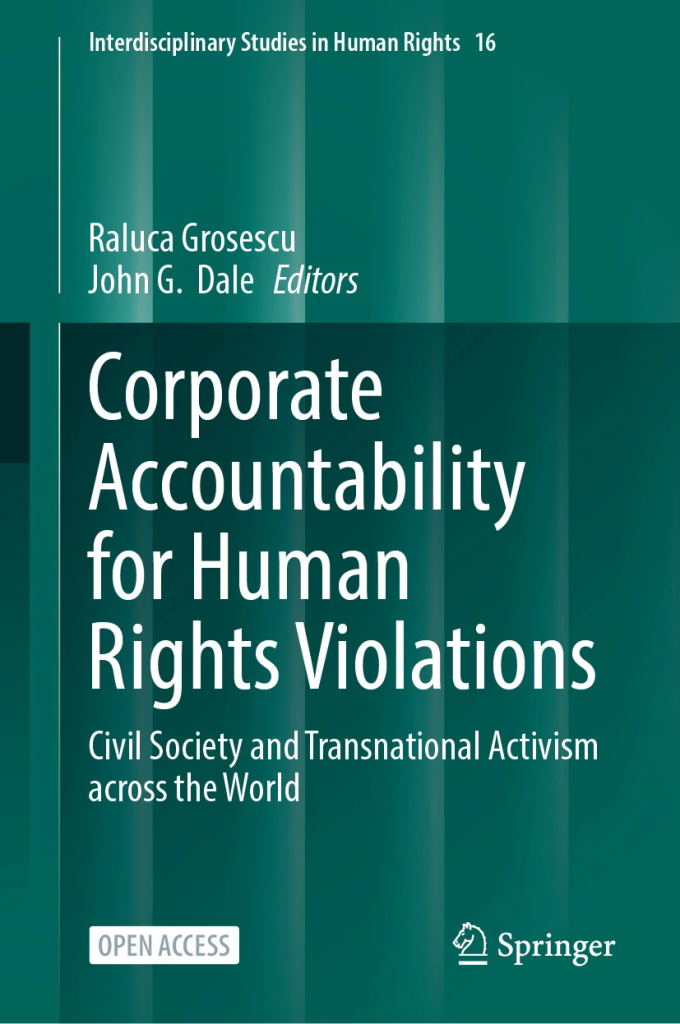
Corporate Accountability for Human Rights Violations: Civil Society and Transnational Action across the World

Grosesçu, Raluca and John G. Dale, eds. Corporate Accountability for Human Rights Violations: Civil Society and Transnational Action across the World (Series on Interdisciplinary Studies in Human Rights, vol.16, Springer Nature, Cham, Switzerland). https://doi.org/10.1007/978-3-032-05569-9.

This edited volume is the first collection to critically explore the role, limitations, and internal fragmentation of social activism for corporate accountability across Africa, the Americas, Asia, and Europe. It analyses a variety of NGOs, trade unions, and grassroots movements and their transnational mobilizations for holding accountable business actors involved in human rights violations and environmental degradation. The book emphasizes the diverse visions and strategies extolled by these civic actors: from civil and criminal litigations, efforts to prohibit and punish business misconduct through national and international legislation, to boycotts, and memorialization projects. By adopting an actor-focused perspective and examining their national and transnational activism, the collection provides an innovative perspective across three main themes: civil society and social movements as key drivers of corporate accountability efforts; the fragmentation of the global corporate accountability movement across ontological, ideological, regional, and professional lines; the Janus-faced paradigm of transnational activism for corporate accountability. The volume argues that corporate accountability coalitions are successful especially when social actors form alliances across borders and professional sectors. Such transnational and intersectoral engagements create counter-hegemonic discourses against corporate impunity, push for more inclusive justice projects, and multiply spaces and ideas of accountability. Yet, civil societies and social movements themselves are fragmenting over the meaning, scope, and tactics of corporate accountability due to different local, national and regional contexts, ideological variations regarding human rights and economic development, and diverse professional understandings of accountability processes. This is an open access book.