Unauthorized Identity Craft: Rethinking “Fraud” in the Study of Migration

Kim, J., & Andrikopoulos, A. (2026). Unauthorized Identity Craft: Rethinking “Fraud” in the Study of Migration. International Migration Review, 0(0).

Crafting identity is integral to the struggle of aspiring migrants to access the territory, labor market, and citizenship of desired destinations. Such practices are at times classified as “fraud.” Migration scholars should approach this state-centered category with caution. Such framing naturalizes the state’s monopolistic claim to the truth of individual identities. It obscures the complex moral terrain migrants navigate. We propose “unauthorized identity craft” (UIC) as an alternative concept. UIC shifts our attention from migrants’ deception to their agency in the absence of state authorization — their learned craft to navigate, and at times subvert, restrictive mobility regimes. Drawing on long-term, multisited ethnographic research with Korean Chinese and West African migrants, we show that UIC is sustained by a complex web of relations, connecting documents, organizations, and people — state and non-state actors alike. The effectiveness of UIC depends on migrants’ intricate and intensive labor to create, maintain, and reshape this relational matrix. Our emphasis on UIC’s relationality enables us to examine how migrants and other actors involved classify their relationships and the various forms of exchange that sustain them. Mismatches in these framings give rise to contestation and negotiation — important elements of the craft migrants must perform. Our relational perspective further helps explain UIC’s temporal dynamic. For some migrants, UIC remains ephemeral, a form of strategic masking; for others, it generates lasting entanglements, moral dilemmas, and enduring identity shifts. We show that UIC’s long-term ramifications are shaped by the breadth, density, durability, and consequentiality of the relational matrix that sustains UIC.
The wages of ethnic power: Socioeconomic status, group threat, and anti-immigrant attitudes in Western Europe

Atac, I. E., Seguin, C., & Gorman, B. (2025). The wages of ethnic power: Socioeconomic status, group threat, and anti-immigrant attitudes in Western Europe. International Journal of Comparative Sociology, 0(0).

Group threat theories explain anti-immigrant attitudes as emerging from threats to the perceived or actual power of one’s ethnic group. Studies also show that individual-level socioeconomic status (SES) is negatively correlated with attitudes toward immigrants, where SES is often conceptualized as an individual-level variable which relates to an individual’s experience of economic competition or general political orientation. Here we argue that the effect of SES is conditional on an individual’s ethnic group’s power. Using data from the European Social Survey and Ethnic Power Relations datasets, we examine how interactions between ethnic group power and individual SES shape attitudes toward immigrants across 16 Western European countries. We find that majority group members generally exhibit more anti-immigrant attitudes than members of minority groups. SES is negatively correlated with anti-immigrant attitudes, generally, but especially for majority group members, where lower-SES individuals have the most anti-immigrant attitudes. At the highest levels of SES there are almost zero differences in anti-immigrant attitudes between majority and minority group members. Our results highlight the need to look to how the “psychological wages” of ethnic group power are influenced by individual SES.

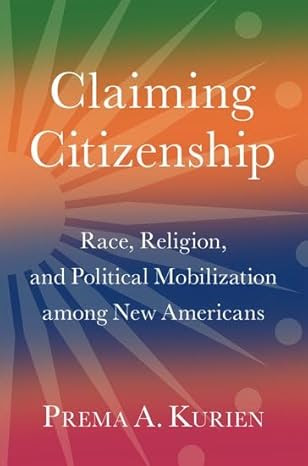
Claiming Citizenship: Race, Religion, and Political Mobilization among New Americans

Kurien, Prema A. 2025. Claiming Citizenship: Race, Religion, and Political Mobilization among New Americans. Oxford University Press.

claiming citizenship

Claiming Citizenship focuses on Indian American civic and political activism in the U.S. public sphere around U.S.-based and India-based issues. Indian Americans are a rising political force whose patterns of activism do not follow the unified model of mobilization of other powerful American ethnic groups. They have multiple types of advocacy organizations: those mobilizing around an Indian American identity; a South Asian American identity; organizations for Indian Americans of Hindu, Sikh, Muslim, Christian, and Buddhist backgrounds; organizations representing Indian American Democrats and Republicans; and even combinations of these such as the Republican Hindu Coalition that mobilized around Donald Trump’s candidacy in 2016. There are also generational differences between second-generation members and the immigrant generation. Unified ethnic mobilization is rare and does not take place through a single professional advocacy organization, or even through well-coordinated campaigns.
The book examines the dialectical process through which immigrants conform to the structures and cultures of the society they have immigrated to, but also work to transform it to accommodate their unique needs. It shows the relative roles played by domestic and international influences on the political mobilization of immigrant groups in the United States as well as the importance of social media in shaping these mobilizations. Claiming Citizenship presents an excellent template to understand how religion, national identity, race, and pan-ethnicity interact in ethnic politics, in addition to examining the role that generational status plays in determining some of these patterns.

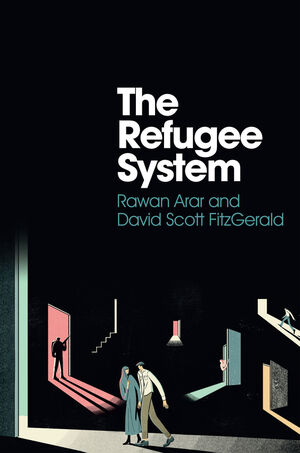
The Refugee System: A Sociological Approach

Arar, Rawan and David Scott FitzGerald. 2022. The Refugee System: A Sociological Approach. Polity Press.

the refugee system

Some people facing violence and persecution flee. Others stay. How do households in danger decide who should go, where to relocate, and whether to keep moving? What are the conditions in countries of origin, transit, and reception that shape people’s options?

This incisive book tells the story of how one Syrian family, spread across several countries, tried to survive the civil war and live in dignity. This story forms a backdrop to explore and explain the refugee system. Departing from studies that create siloes of knowledge about just one setting or “”solution”” to displacement, the book’s sociological approach describes a global system that shapes refugee movements. Changes in one part of the system reverberate elsewhere. Feedback mechanisms change processes across time and place. Earlier migrations shape later movements. Immobility on one path redirects migration along others. Past policies, laws, population movements, and regional responses all contribute to shape states’ responses in the present. As Arar and FitzGerald illustrate, all these processes are forged by deep inequalities of economic, political, military, and ideological power.

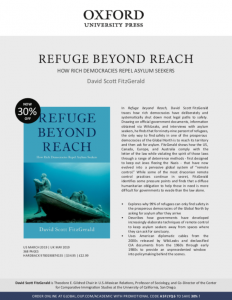
Refuge Beyond Reach: How Rich Democracies Repel Asylum Seekers

FitzGerald, David Scott. 2019. Refuge Beyond Reach: How Rich Democracies Repel Asylum Seekers. Oxford University Press.

Refuge Beyond ReachIn Refuge beyond Reach, David Scott FitzGerald traces how rich democracies have deliberately and systematically shut down most legal paths to safety. Drawing on official government documents, information obtained via WikiLeaks, and interviews with asylum seekers, he finds that for ninety-nine percent of refugees, the only way to find safety in one of the prosperous democracies of the Global North is to reach its territory and then ask for asylum. FitzGerald shows how the US, Canada, Europe, and Australia comply with the letter of the law while violating the spirit of those laws through a range of deterrence methods – first designed to keep out Jews fleeing the Nazis – that have now evolved into a pervasive global system of “remote control.” While some of the most draconian remote control practices continue in secret, FitzGerald identifies some pressure points and finds that a diffuse humanitarian obligation to help those in need is more difficult for governments to evade than the law alone.