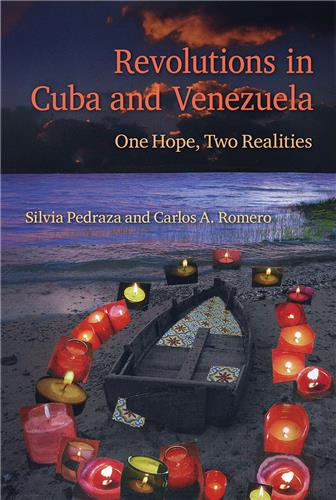
Pedraza, Silvia and Carlos A. Romero. 2022. Revolutions in Cuba and Venezuela: One Hope, Two Realities. University Press of Florida.
Revolutions in Cuba and Venezuela compares the sociopolitical processes behind two major revolutions—Cuba in 1959, when Fidel Castro came to power, and Venezuela in 1999, when Hugo Chávez won the presidential election. With special attention to the Cuba-Venezuela alliance, particularly in regards to foreign policy and the trade of doctors for oil, Silvia Pedraza and Carlos Romero show that the geopolitical theater where these events played out determined the dynamics and reach of the revolutions.
Updating and enriching the current understanding of the Cuban and Venezuelan revolutions, this study is unique in its focus on the massive exodus they generated. Pedraza and Romero argue that this factor is crucial for comprehending a revolution’s capacity to succeed or fail. By externalizing dissent, refugees helped to consolidate the revolutions, but as the diasporas became significant political actors and the lifelines of each economy, they eventually served to undermine the social movements.
Using comparative historical analysis and data collected through fieldwork in Cuba and Venezuela as well as from immigrant communities in the U.S., Pedraza and Romero discuss issues of politics, economics, migrations, authoritarianism, human rights, and democracy in two nations that hoped to make a better world through their revolutionary journeys.