Reactionary Bricolage: Curtis Yarvin and Postliberalism

Rosenberg, J. (2026). Reactionary Bricolage: Curtis Yarvin and Postliberalism. Theory, Culture & Society, 0(0).

As the authoritarian right advances in the United States, developing an accurate understanding of the constituent elements of its worldview is a task of great urgency. Toward this end, I assess the writings of Curtis Yarvin, one of the US right’s most influential intellectuals. Yarvin’s novelty consists in his syncretic blend of non-liberal, non-democratic social theory with a computational understanding of society. Considering this work offers valuable insights into ascendant anti-democratic and computational styles of thought. In light of Yarvin’s influence on powerful figures in the Trump administration, this is by no means an academic exercise, but one with very high political stakes. Simply put, Curtis Yarvin may have something important to tell us not just about where we are, but also about where we are headed.
Two-layer panopticon: how the Chinese government uses digital surveillance to prevent collective action

Han Zhang, Two-layer panopticon: how the Chinese government uses digital surveillance to prevent collective action, Social Forces, 2025;, soaf194, https://doi.org/10.1093/sf/soaf194

Authoritarian regimes increasingly use digital surveillance to suppress collective action. Existing accounts emphasize how dictators use mass surveillance of citizens to gather information and deter mobilization, but overlook their continued reliance on human agents, whose shirking often undermines repression. We propose a two-layer Panopticon framework for digital surveillance. Dictators can directly surveil citizens. They can also surveil the frontline agents responsible for implementing repression, reducing shirking and improving prevention. We test this framework in China using an original dataset of 51,611 government procurement contracts that captures digital workplace surveillance of agents alongside mass surveillance of citizens. We find that each layer independently reduces protest and that their interaction produces modestly reinforcing effects. Causal mediation analysis reveals an asymmetric mechanism: about one-third of the protest-reducing effect of citizen surveillance operates through increased oversight of agents, while agent-facing surveillance reduces protest directly. These results remain robust across dynamic panel models, instrumental variables, and alternative protest data. This article bridges and extends research on state repression, principal–agent problems in bureaucracy, and digital authoritarianism, offering new theoretical and empirical insights into how digital technologies strengthen the practice of authoritarian rule.

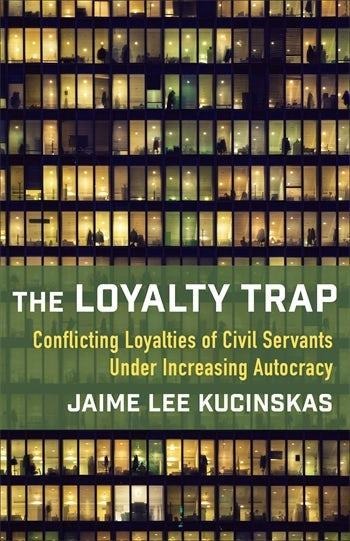
The Loyalty Trap: Conflicting Loyalties of Civil Servants under Increasing Autocracy

Kucinskas, Jaime Lee. 2025. The Loyalty Trap: Conflicting Loyalties of Civil Servants under Increasing Autocracy: Columbia University Press.

Donald J. Trump took office threatening to run roughshod over democratic institutions, railing against the federal bureaucracy, and calling for dismantling the administrative state. How do civil servants respond to a presidential turn toward authoritarianism? In what ways—if any—can they restrain or counter leaders who defy the norms of liberal democratic governance?