Reactionary Politics in South Korea: Historical Legacies, Far-Right Intellectuals, and Political Mobilization

Yang, M. (2025). Reactionary Politics in South Korea: Historical Legacies, Far-Right Intellectuals, and Political Mobilization. Cambridge: Cambridge University Press.
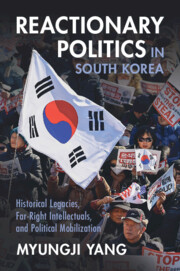
In December 2024, South Korean president Yoon Seok-yeol stunned the world by declaring martial law. More puzzling was that Yoon’s insurrection unexpectedly gained substantial support from the ruling right-wing party and many citizens. Why do ordinary citizens support authoritarian leaders and martial law in a democratic country? What draws them to extreme actions and ideas? With the rise of illiberal, far-right politics across the globe, Reactionary Politics in South Korea provides an in-depth account of the ideas and practices of far-right groups and organizations threatening democratic systems. Drawing on eighteen months of field research and rich qualitative data, Myungji Yang helps explain the roots of current democratic regression. Yang provides vivid details of on-the-ground internal dynamics of far-right actors and their communities and worldviews, uncovering the organizational and popular foundations of far-right politics and movements.

The fortunes of radicalization: How the party environment determined the fate of radical movements in the late 20th-century United States

Grumbach, M. (2026). The fortunes of radicalization: How the party environment determined the fate of radical movements in the late 20th-century United States. Critical Sociology, 0(0).

Radicalization during the 1960s and 1970s is often cited as a cause in the decline of American New Left movements, but right-wing movements also radicalized during this period and did not suffer the same consequences. This comparative-historical study traces the trajectories of four sectarian radicals who led conservative Christian and ultra-left movements that emerged in the United States in 1965. Bridging social movement literature with Gramscian theory, I argue that the variation in the fortunes of radicalization stems from the divergence between the formal party blocs. Radicalization on the left resulted in isolation and implosion because the Democratic Party bloc lacked resources and its interest-group configuration was inhospitable to radicalism. On the right, the Republican Party bloc was in an ascendant phase of organizational growth and fused the hitherto dispersed ideological currents of social conservatism and market fundamentalism. The availability of resources in tandem with the hegemonic configuration of the Republican Party bloc enabled Christian radicals to exert ideological influence. My findings demonstrate how parties shape the trajectories and outcomes of radicalization and underscore the importance of comparative analysis of left and right movements to explain their political legacies.

General Social Theory or Resistant Knowledge Project?: The Public Life of Social Constructionism and Its Implications for Liberation Sociology

Allen, S. E.2025. “General Social Theory or Resistant Knowledge Project?: The Public Life of Social Constructionism and Its Implications for Liberation Sociology.” Sociological Forum40, no. S1: S29–S37. https://doi.org/10.1111/socf.70015.

This paper explores contemporary conceptualizations of social constructionism. I specifically address three queries: (1) What is social constructionism? (2) How have understandings of social constructionism evolved as the concept has diffused into the public sphere? And, (3) In what ways does social constructionism’s public life impact liberation sociology in praxis? I ultimately argue that social constructionism, as a theory and framework, draws attention to the significant ways one’s standpoint epistemology influences knowledge construction and, as a result, has the radical potential to destabilize social systems and hierarchies by legitimizing socially situated viewpoints, especially those from oppressed and marginalized communities. Furthermore, I discuss how this framing shifts social constructionism from merely a general social theory to a resistant knowledge project to explain why it has faced challenges in the form of reductionism and repression. I conclude by acknowledging the continued utility of social constructionism moving forward, especially with regard to cultivating a liberation sociology.

Democracy Under Siege: The Demise of Successful United States Federal Campaign Finance Reform

Stryker R, Neff O. Democracy Under Siege: The Demise of Successful United States Federal Campaign Finance Reform. Studies in American Political Development (2026): 1–24. https://doi.org/ 10.1017/S0898588X25100308

Private funding of U.S. federal elections is at record levels, with most money contributed by a few very wealthy individuals and organizations. Cross-partisan majorities of the American public consistently express concern, and proposed campaign finance reforms are introduced as frequently in Congress recently as earlier in time. Despite these facts, and that successful twentieth century reforms often were preceded by corruption scandal, that these continue today, that there remain political entrepreneurs for reform, that reformers continue to use corruption framing, and that the Supreme Court’s 2010 Citizens United decision left some reform strategies open, no proposed campaign finance reforms to curb moneyed interests’ influence have been enacted since the 2002 BCRA. We address this puzzle through comparative process tracing of forty reform efforts receiving consideration in a congressional committee from 1907 to 2024. We identify three ideal-type reform trajectories—scandal as agenda-setter, the Supreme Court as agenda-setter, and a multiple legislative trajectories type—through which campaign finance reforms through 2002 sometimes were successful. We then show how and why a combination of changes in the political, media, and legal environments doomed reform efforts post-2002 and especially post-2010 to almost certain failure. We draw implications for federal political discourse and policy-making more generally.

Why Don’t South Asians in the U.S. Count As “Asian”?: Global and Local Factors Shaping Anti-South Asian Racism in the United States*

Kurien, P. and Purkayastha, B. (2024), Why Don’t South Asians in the U.S. Count As “Asian”?: Global and Local Factors Shaping Anti-South Asian Racism in the United States*. Sociol Inq, 94: 351-368. https://doi.org/10.1111/soin.12592

In a 2020 U.S. survey, more Asian Indians than Chinese indicated that they were worried about post-Covid-19 hate crimes. Yet, post-Covid violence against people of Asian background has been viewed as being directed against “Chinese-looking” individuals. This is just one example of how South Asians are overlooked in discourses about Asian Americans. This theoretical paper provides an expansion of the racial formation framework to explain this exclusion. We demonstrate how global factors, including the foreign engagements of the United States shaped the development of the Asian American group and category, and why, even though Asian Americans can be brown, yellow, white, or black, an East Asian phenotype is viewed as denoting an “Asian” body in the United States. We also discuss how the racialization of religion shapes anti-South Asian racism, a factor largely ignored in the literature on racial formation and Asian Americans. We end by calling for the inclusion of South Asians in Asian American literature to challenge many of the reigning paradigms regarding Asian America and anti-Asian racism.