Dispossessory Citizenship: The Settler Colonial State and the Bureau of Indian Affairs’ Relocation Program, 1952–1972 

Peter Kent-Stoll, Dispossessory Citizenship: The Settler Colonial State and the Bureau of Indian Affairs’ Relocation Program, 1952–1972, Social Problems, Volume 71, Issue 4, November 2024, Pages 1014–1031, https://doi.org/10.1093/socpro/spac054

Through the Bureau of Indian Affairs (BIA) relocation program starting in 1952, the United States sought to terminate federal trust restrictions for American Indians and while relocating reservation and rural-residing Indigenous people to cities to be assimilated into the American “mainstream.” I analyze the BIA’s program as part of the specifically settler colonial structure of the U.S. state. Using primary and secondary sources, I ask what explains the BIA’s shifting spatial strategies and imaginaries from the rise of the relocation program to its demise? The BIA’s project derided reservations as fiscal burdens, depicted the postwar city as a place of “Indian freedom,” engaged in gendered surveillance of Indigenous families, and negated Indigenous peoples’ histories in U.S. cities. As the program ended, the BIA shifted rhetoric from assimilation to self-determination to maintain the settler colonial relation while paying lip service to critiques of the colonial tactics of relocation. These different moments of the relocation project articulated a type of dispossessory citizenship as a racial and empire state strategy of enacting and justifying settler colonialism. This work analyzes the settler colonial dimensions of the state and its technologies of violence and territory used when it presents itself as supposedly moving past its colonial past.
The soft power cost of COVID-19 in OECD countries: a lose–lose outcome for China and the United States

Thomas, J. R., Liang, L., Sonoda, S., & Xie, Y. (2025). The soft power cost of COVID-19 in OECD countries: a lose–lose outcome for China and the United States. International Political Science Review, 46(4), 557-574.

One way in which many scholars of public opinion have operationalized a country’s soft power abroad is to measure how favorably that country is viewed by people in foreign countries. While earlier research has demonstrated the mechanisms and factors correlated with how foreigners perceive a country, much less is known about how sudden and unexpected global events may impact how favorably citizens of different countries view another country. Analyzing recent Pew Global Attitudes Survey data, we assess how the COVID-19 pandemic changed public opinions of China and the United States—with Russia as a reference—in 12 OECD countries. Our analysis reveals that COVID-19 led to a decline in favorability toward both the US and China—the ‘soft power cost’ of COVID-19. While the cost is larger for China than for the US in most countries, we observe exceptions in Germany, Italy, and South Korea. We also explore the heterogeneity of the soft power cost by respondents’ individual attributes and other attitudes such as how COVID-19 impacted their lives.

Unauthorized Identity Craft: Rethinking “Fraud” in the Study of Migration

Kim, J., & Andrikopoulos, A. (2026). Unauthorized Identity Craft: Rethinking “Fraud” in the Study of Migration. International Migration Review, 0(0).

Crafting identity is integral to the struggle of aspiring migrants to access the territory, labor market, and citizenship of desired destinations. Such practices are at times classified as “fraud.” Migration scholars should approach this state-centered category with caution. Such framing naturalizes the state’s monopolistic claim to the truth of individual identities. It obscures the complex moral terrain migrants navigate. We propose “unauthorized identity craft” (UIC) as an alternative concept. UIC shifts our attention from migrants’ deception to their agency in the absence of state authorization — their learned craft to navigate, and at times subvert, restrictive mobility regimes. Drawing on long-term, multisited ethnographic research with Korean Chinese and West African migrants, we show that UIC is sustained by a complex web of relations, connecting documents, organizations, and people — state and non-state actors alike. The effectiveness of UIC depends on migrants’ intricate and intensive labor to create, maintain, and reshape this relational matrix. Our emphasis on UIC’s relationality enables us to examine how migrants and other actors involved classify their relationships and the various forms of exchange that sustain them. Mismatches in these framings give rise to contestation and negotiation — important elements of the craft migrants must perform. Our relational perspective further helps explain UIC’s temporal dynamic. For some migrants, UIC remains ephemeral, a form of strategic masking; for others, it generates lasting entanglements, moral dilemmas, and enduring identity shifts. We show that UIC’s long-term ramifications are shaped by the breadth, density, durability, and consequentiality of the relational matrix that sustains UIC.

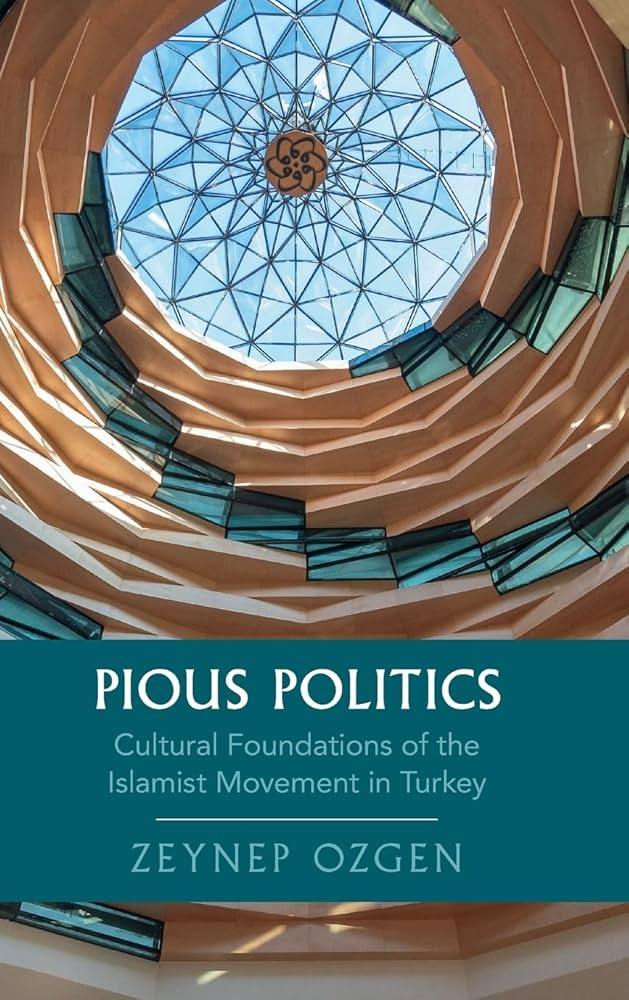
Pious Politics: Cultural Foundations of the Islamist Movement in Turkey

Ozgen, Z. (2025). Pious Politics. In Pious Politics: Cultural Foundations of the Islamist Movement in Turkey (pp. i–i). half-title-page, Cambridge: Cambridge University Press.

A sociological examination of the rise and resilience of Islamist politics in contemporary Turkey. Drawing on two years of research, Zeynep Ozgen explores religious political contention and, more broadly, the complex relationship between culture and politics in shaping reality.

Individual characteristics and European identity: a meta-analysis

Fernández, J. J., Bedasheva, O., & Durban, M. (2026). Individual characteristics and European identity: a meta-analysis. Journal of European Public Policy, 1–30. https://doi.org/10.1080/13501763.2026.2619001

Scholars and policymakers concur that widespread European identification is a prerequisite for European integration. The centrality of the we-feeling for this process has led to many studies exploring its individual-level determinants. However, the findings reported by previous studies are often inconsistent and literature reviews only cover a fraction of all works. To advance our understanding of this form of support for European integration, this article conducts the first meta-analysis of individual-level determinants of European identification. It synthesises the findings of 85 social science studies on affective or cognitive forms of identification with Europe. Inspired by the utilitarian, cognitive mobilisation, transnationalist and cultural-political accounts of this we-feeling, we assess the effects of 15 individual-level characteristics for which there are sufficient estimates. The findings underscore the multidimensional and multi-causal origins of European identification. Thirteen of the considered predictors have a robust association with this we-feeling. Individuals who have higher socioeconomic status (measured by five indicators), are engaged in transnational activities, are more engaged with politics, are left-of-center, trust the EU, live in urban settings and are attached to their country display more European identification than those without these characteristics. Also importantly, none of those factors have a disproportionately larger association.