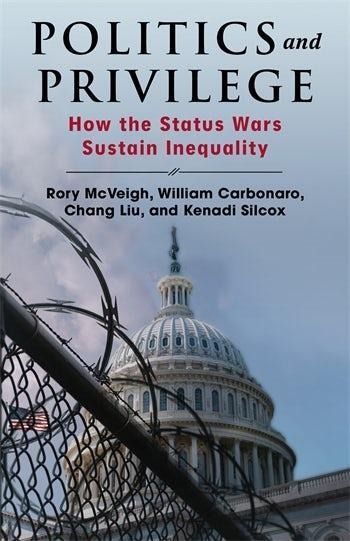
Politics and Privilege: How the Status Wars Sustain Inequality

McVeigh, Rory, William Carbonaro, Chang Liu and Kenadi Silcox. 2025. Politics and Privilege: How the Status Wars Sustain Inequality: Columbia University Press.

In the United States, the bottom 50 percent of households hold only 1 percent of the nation’s wealth. Scholars and commentators have long viewed democracy as the antidote to economic inequality, but US electoral politics bears little resemblance to a struggle between the haves and the have-nots. What makes extreme disparities of wealth and income so persistent, and why has the political process failed to address the problem?

Rethinking Spatial Inequality

Lobao, Linda M and Gregory Hooks. 2025. Rethinking Spatial Inequality: Edward Elgar Publishing.

This illuminating book offers a new perspective on social science inquiry into the spatial dimensions of societal well-being; addressing the key question of who gets what, and where.

Leading scholars Linda M. Lobao and Gregory Hooks adopt an organizing framework that speaks to the concept of spatial inequality, how it forms a lens on societal disparities, and how it gives rise to work with underlying commonalities across different social science disciplines. With this scaffolding, the authors consider spatial inequality across spatial scales, places, and populations, including the subnational scale, so often missing in inequality research. Illustrative cases center on poverty, public service provision and austerity policies, environmental justice, and war and conflict. The book concludes by advancing an integrative social science agenda to guide future emancipatory research on inequality.

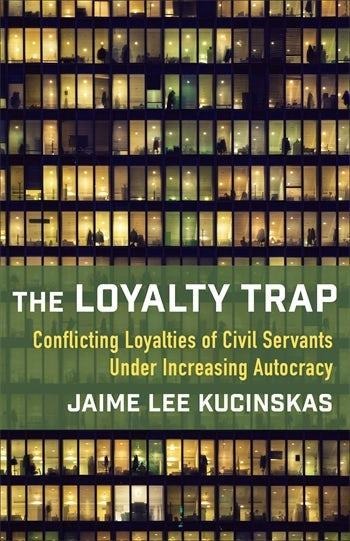
The Loyalty Trap: Conflicting Loyalties of Civil Servants under Increasing Autocracy

Kucinskas, Jaime Lee. 2025. The Loyalty Trap: Conflicting Loyalties of Civil Servants under Increasing Autocracy: Columbia University Press.

Donald J. Trump took office threatening to run roughshod over democratic institutions, railing against the federal bureaucracy, and calling for dismantling the administrative state. How do civil servants respond to a presidential turn toward authoritarianism? In what ways—if any—can they restrain or counter leaders who defy the norms of liberal democratic governance?

Is Inequality the Problem?

Kenworthy, Lane. 2025. Is Inequality the Problem?: Oxford University Press.

Increasing economic inequality is now one of the most studied subjects in the social sciences. The general view is that while its increase represents a bad social outcome in and of itself, its negative impact extends into numerous other realms of social life: declines in living standards for those in the lower deciles of the income ladder, worse health outcomes, reductions in happiness, and less opportunity for most.

In Is Inequality the Problem?, Lane Kenworthy draws from a vast trove of research on the rich democracies to argue that while inequality is normatively a problem and we should therefore work to reduce it, the evidence from wealthier countries does not show that income inequality has contributed much at all to the other social ills it is associated with, like poor health outcomes. The effects vary from society to society, but typically the key contributors to negative trends like this one are factors other than inequality. Instead of trying to improve living standards, democracy, opportunity, health, and happiness indirectly via reduction in income inequality or wealth inequality, policy makers are more likely to make progress by pursuing these goals directly.
Rethinking Symbolic Interactionism

Janoski, Thomas. 2025. Rethinking Symbolic Interactionism: Edward Elgar Publishing.

This discerning book critically analyzes the key principles of symbolic interactionism, outlining their strengths and examining current weaknesses. Thomas Janoski provides novel insights into the theory, rethinking some of its foundations while adhering to its basic symbolic principles of the self.